Vertically integrated quantum photonics — from crystal engineering to system-level entangled photon source design.
Spontaneous Parametric Down-Conversion (SPDC) is the cornerstone nonlinear optical process that converts a single high-energy pump photon into a pair of lower-energy entangled photons (signal and idler). NantQ's platform is built on collinear Type-II quasi-phase-matched SPDC in periodically poled lithium niobate (PPLN) waveguides.
In Type-II SPDC, the signal and idler photons emerge with orthogonal polarizations, enabling straightforward polarization-entanglement and deterministic photon-pair separation without bulk optics.
Our waveguide geometry confines the optical modes to a few microns, dramatically increasing the nonlinear interaction length and pair generation rate compared to bulk crystals — producing brighter sources in a fraction of the footprint.
Six core competencies that differentiate NantQ's quantum photon sources.
Precision periodic poling of lithium niobate crystals with custom grating periods for exact phase-matching at target wavelengths. Our poling process achieves duty cycles > 48% for maximum nonlinear efficiency.
Titanium stripe diffusion at high temperature creates low-loss single-mode waveguides in LiNbO₃. This proven process supports both TE and TM modes essential for Type-II phase matching.
By periodically inverting the crystal's ferroelectric domains, we achieve first-order QPM that accesses the largest nonlinear coefficient (d₃₃) of lithium niobate, maximizing pair brightness.
Factory-aligned PM and SMF pigtails with < 1 dB coupling loss. Hermetically sealed packages with integrated TEC ensure long-term stability in rack-mount and field environments.
Proprietary PTC controllers maintain crystal temperature to ±0.01°C, locking the QPM condition and ensuring spectral stability of entangled photon pairs over hours of continuous operation.
From pump laser selection through SPDC chip, spectral filtering, to fiber output — NantQ integrates every stage into a single instrument with touchscreen control and remote monitoring capabilities.
Key performance metrics from the QLS-1550-TYPE-II-M platform.
Visibility Interference
Heralding Efficiency
Bi-Photon Bandwidth
Telecom C-Band
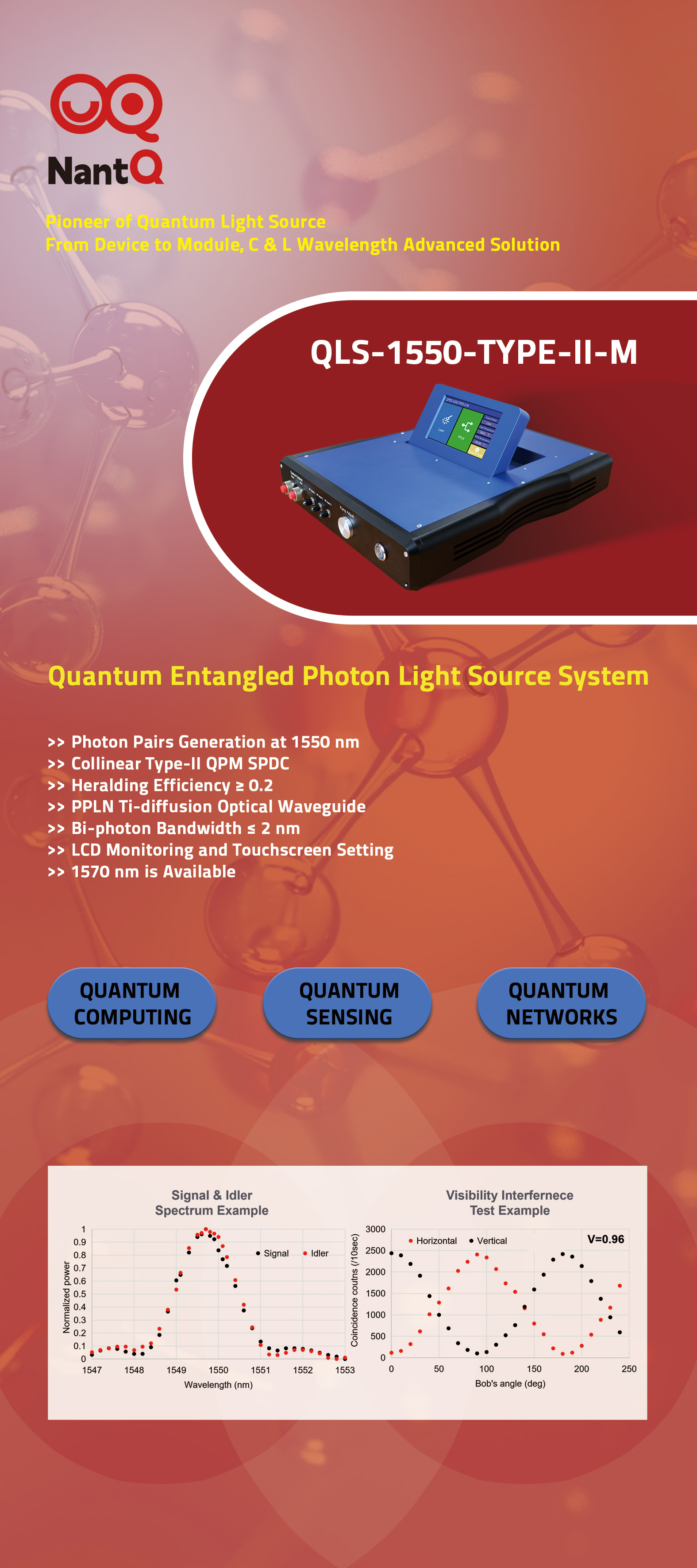
Our SPDC sources produce well-separated signal and idler peaks centered at 1550 nm. The collinear geometry ensures high spectral overlap and collection efficiency into single-mode fiber.
Narrow bi-photon bandwidth (≥ 2 nm FWHM) enables efficient spectral filtering while maintaining high pair rates, critical for multi-channel quantum network deployments.
Hong-Ou-Mandel and polarization-basis measurements demonstrate visibility V = 0.96, well exceeding the classical limit of 0.5 and confirming genuine quantum entanglement.
High visibility directly translates to lower quantum bit error rates (QBER) in QKD applications, enabling longer secure key generation distances over deployed fiber networks.
Request datasheets, application notes, and integration guides for NantQ's quantum photon source technology.
Request Documentation →